2010-05-31
|
In Memoriam
In the USA, today is Memorial Day, when the war dead are memorialized. By extension, it is also a time to remember the dead among our family and friends; it is the secular equivalent to All Soul’s Day for an irreligious nation. We can also use the occasion to meditate on our own deaths, something we forget to do. Forgetting, sleeping, and death are all manifestations of a similar process.
|
With my own struggles with illness fresh in my mind, the death yesterday of Dennis Hopper is particularly memorable. For this writer, Mr. Hopper was at one point in his life what is called a “role model”. I want to use E. F. Schumacher’s “Four Fields of Knowledge” to explore what that could mean. First of all, there is the I and the not-I, or “world”, or even “you”. Those are both the subjects and objects of knowledge. Thus our knowledge derives from two sources: “Inner Experience” and “Outer Appearance”. This leads to the following schematization:
| |
Source |
| I |
I — inner |
I — outer |
| You/It |
You/It — inner |
You/It — outer |
This leads us to four questions:
- Who am I?
- What is the inner experience of others?
- How do I appear to others?
- What is happening in the external word?
Question 2 relates to empathy and 4 leads to science, but for our purposes, I will explore 1 and 3.
Dennis Hopper succeeded at level 3: he was known — at least in his exteriority — to millions. In his breakout move, Easy Rider, he and Peter Fonda succeeded in creating an image that many in that generation aspired to copy. Leaving aside the wisdom of roaming aimlessly on the highways on a motorcycle, or the use of mind-altering chemicals, it was still an image that captured the imaginations of millions, even if very few could succeed in pulling it off. But it was all exteriority, a pose, and it seems that Mr. Hopper remained in that mode his entire life. It was a life tied to the sensuous world and only the few with the looks, charm, and money can master that world, at least for a season, until the inevitable corruption arrives.
Some few men will turn aside from the sensuous world and seek to know themselves, not as another object in the world, but as the subject and agent of their own life. Then question 3 becomes irrelevant (except for those who play the guru game), and the focus is on question 1. Even for most of them, it is a transitory, not a permanent, condition. Therefore, it is important to remember to turn aside from the sensuous world to the higher world.
Yesterday, I took a walk along the beach and did the following exercise. I recalled that state of consciousness called dispassion, or apatheia, and then as I observed the things in the world, I would begin to detach from them. There may be a short twinge of sadness or regret at having to give these things up, but that passes as the sense of detachment grows. This is called dying before you die.
Copyright © 2009, 2010 Gornahoor Press
2010-05-30
 |
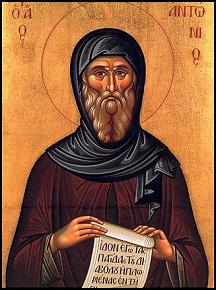
What follows are some of the main theme’s of St Anthony’s “Counsels on the Character of Men and on the Virtuous Life”, from the Philokalia, Volume I, translated by Constantine Cavarnos. Dr. Cavarnos includes copious footnotes relating St Anthony’s essay to biblical passages, apparently to counteract the claims of the first translators, which we have previously documented. Nevertheless, it is unlikely you will hear these themes in a Sunday sermon, or from a TV preacher.
NOTE: direct quotes are in quotations or marked by a blue vertical line.
|
Practical Reason
Men are improperly called rational; it is not those who have learned thoroughly the discourses and books of the wise men of old that are rational, but those who have a rational soul and can discern what is good and what is evil, and avoid what is evil and harmful to the soul, but zealously keep, with the aid of practice, what is good and beneficial to the soul …
The “book learning” St Anthony refers to may be called “theoretical reason”. But what makes a man truly rational is the “practical reason”, that is, the ability to choose ones ends or goals and the means to achieve them. Since man is the “rational animal”, someone who does not possess practical reason is really “inhuman”, being more like the irrational animals.
Just as helmsmen steer the ship in the proper direction in order to avoid hitting a reef or shoal, so let those who aspire after the virtuous life consider carefully what they ought to do and what they ought to avoid.
Freedom
Those who “are free in their life and ways”, are properly called free.
Freedom and happiness of the soul consist in genuine purity and contempt of transitory things.
Characteristics
A truly rational and virtuous soul is recognized from a man’s look, walk, voice, laughter, manner of spending his time, and the circumstances of his life. Everything in such a soul has been thoroughly changed and corrected so as to become graceful.
A virtuous life is like a work of art, with the soul as artist:
Like skilled painters and sculptors, it is by their words that they display their virtuous and God-loving way of life.
Rulers
Examine the things that pertain to you, and prove for yourself that rulers and masters have authority only over the body, not over the soul; and let this always be before your mind.
This is even more important in our day when propaganda has become a science. Pay attention to the sources of your concepts and values to determine if they are truly good, or simply absorbed from the mass media.
Vigilance
The soul’s “God-loving rational faculty, being a vigilant gatekeeper, bars entry to evil and ugly thoughts.” We are accustomed to regarding thoughts as our own, without considering the source. We are bombarded by thoughts; they are the key to influencing our behavior. A man must be the detached observer of his thoughts, paying attention to their origin, before latching onto a thought and letting it guide his actions.
Obstacles
St Antony lists many obstacles to a virtuous life. Again, the point is not to be “good” in order to get a reward, but rather to recognize those attitudes that prevent us from leading the rational life. The spirit [nous, mind] must guide the soul which masters the body. The “passions”, on the other hand, make us passive, not the active agent of our life. In one place he lists “lust, love of glory, and ignorance”. In another, “conceit, arrogance, deception, envy, avarice”. The point is that these temptations tie us to transitory things, dominate the soul, and thus prevent our full use of reason and freedom.
Many paths
Through God’s love for man, there are many paths that lead men to salvation, ways that convert men and lead them to the Heavens.
Copyright © 2009, 2010 Gornahoor Press
2010-05-25
The Kingdom of Heaven suffers violence and the violent take it by force. (Matthew 11:12)
 |
There is a new edition of Volume I of the Philokalia translated by Constantine Cavarnos and published by the Institue for Byzantine and Modern Greek Studies. Philokalia means “Love of the Beautiful” (not “beautiful things”) and serves as a guidebook for early Christian spiritual practices. Besides the Bible, the works included in the Philokalia are heavily influenced by Platonic notions; it would even be reasonable to speculate that, as such, it includes spiritual practices that were part of the training at Plato’s Academy. This work is recommended as essential to the recovery of the “metaphysical view prior to the scholastic age”.
|
The differences between the Philokalia and contemporary manifestations of Christianity are striking.
- Salvation. Salvation is the process of theosis, or divinization, that is, becoming like God. This differs from both from
- the Roman notion that salvation comes from following a set of moral norms and seeking reconciliation after sinning, and
- the Protestant notion of imputed righteousness devoid of any real, actual, and effective change.
-
Effort. Theosis requires conscious efforts, both physical and spiritual. Some of the latter include concentration, meditation, inner attention, and mental prayer. All these involve control of thought so it doesn’t wander aimlessly.
-
Rational. The necessary first step is to be “rational”, that is, in harmony with the Logos. Hence, irrationality, ungrounded exuberance, and blind faith are obstacles on the path.
-
Transformation. The end result is the transformation of one’s level of being. Every man is in the image of God, but few are in the likeness of God. According to St Antony, the former are barely human and should be avoided.
Although these writings are geared to the contemplative life (Guenon), we agree with Evola that the way of action is a valid path for certain personalities. Hence, some adaptations need to be made in the latter case. In more contemporary terms, we may call one path the Way of the Monk, and the other, the Way of the Man in the World.
NOTE: The first essay in the Philokalia is attributed to St Antony and concerns the attributes and qualities of a rational man. In the first English edition translated by Palmer, Sherrard, and Ware, this essay is removed from its prime position and relegated to a mere appendix on the grounds it is insufficiently “Christian”. I’ll not bother with their reasons, since all this demonstrates is the incomprehensibility of early Christianity to our contemporaries, who even claim to be Christian leaders. Let this serve as a warning to anyone seeking authentic Christian doctrine and spirituality. What the first translators have done is to split the Western tradition in two, and detach the Christian religion from the Primordial Tradition.
Copyright © 2009, 2010 Gornahoor Press
2010-05-23
 |
Joseph de Maistre was an Hermetist (in the school of Martines de Pasqually and Louis-Claude de Saint-Martin), Traditionalist, Reactionary, European, and a source of the Russian Idea. In his Self-Defense, Julius Evola includes Maistre among those well-bred men holding sane and normal views common prior to the French Revolution. In this brief review of the Maistre’s St Petersburg Dialogues Evola again reveals his high regard for de Maistre, despite their fundamental disagreement on religion and providence.
|
In Materialism and the Task of Anthroposophy, Rudolf Steiner says this about Joseph de Maistre:
With de Maistre, a personality of the greatest imaginable genius, of compelling spirituality but Roman Catholic through and through, appears on the scene.
High praise indeed, especially from a man who was in fundamental disagreement with de Maistre.
DIGRESSION: To complete the circle, we have mentioned that Evola included Steiner’s picture not once, but twice, as demonstrating “spiritual penetration”, despite being in fundamental disagreement with Steiner’s doctrines of Karma and Reincarnation. So here we have the example of three esoterists demonstrating respect despite their disagreements on specific issues. This is how men of high intellectual attainment behave, since they understand what “thinking” is. Lesser men treat thought as a weapon, and means of combat. They confuse the use of words and ideas, with the words and ideas themselves. Let this serve as a model.
To return to the topic. Steiner has some interesting things to say about de Masitre who represents the reactionary trend to Steiner’s progressivist view of mankind. This is how he characterizes de Maistre’s basic worldview:
All of humanity falls into two categories, one representing the kingdom of God, the other representing the kingdom of this world.
As we just pointed out, this is also the view of Vladimir Solovyov, and the reason for this seeming coincidence will become clear. But the point is that there is an essential difference in the quality of being between the two groups of humanity, on spiritually aware, the other not. This is more than a superficial adherence to on system of belief over another, but represents a real change in the level of being.
Steiner writes: “there are those in Europe who cling to this view that since the beginning of the fifteenth century divine world rule has assumed a quite different position in regard to earth humanity.” Of course, this is not just representative of the Catholicism of de Maistre, but it also reflects the point of view of both Julius Evola and Rene Guenon, who saw the Reformation as the beginning of the end of the last vestiges of Traditional civilization in the West.
Steiner astutely points this out:
De Maistre had the grandiose idea to tie in with Russianism, particularly with the element that had found its way since ancient times from Asia into the Orthodox Catholic, Russian religion. From there, he wished to create a connection to Romanism. He tried to bring about the great fusion between the element living in the Oriental manner of thinking in Russian culture, and the element coming from Rome. already imbued with this view.
Here we see this revealed in the writings Solovyov who in his own way tries to tie the “Oriental manner of thinking” into contemporary Western ideas.
Steiner continues:
de Maistre refers back to what Christianity was in regard to its metaphysical view prior to the scholastic age, what it was in the first centuries and what was acceptable to Rome. De Maistre aimed for Roman, for Catholic, Christianity as a real power.
Again, as Evola also points out, the Catholic counter-reformation was not enough, it only went back half-way. It needed to return to the primordial sources of its spiritual power. Instead of being the opposite of a Reformation, it merely contented itself with being a reformation in the opposite direction. The spiritually weak state of Christianity today is the result.
Steiner’s short essay puts the issue in perfect clarity.
- Is the human race on the way to some progressive, evolutionary, utopian future?
- Or is there a fundamental and irreconcilable divide between those on the side of Tradition and those on the side of Revolution?
If the latter, then the task is to begin the reconstruction of Tradition from the insights given by de Masitre, Solvoyov, Guenon, and Evola.
NOTE: The idea the evolution and progress of the human reace is one of the features that distinguish “New Age” teachings from Tradition.
Copyright © 2009, 2010 Gornahoor Press
2010-05-22
- The stone exists
- The plant exists and is living
- The animal lives and is conscious of its life in its concrete states
- Man understands the meaning of life according to ideas
- The sons of God actively realise this meaning of the perfect moral order in all things to the end.
~ Vladimir Solovyov, The Justification of the Good
Commentary
This schema separates Solovyov’s system (and ipso facto all Traditions) from humanisms and a fortiori Marxism. There is a spiritual Kingdom of spiritually aware men that is as different from the worlds of material men as the latter are from mammals.
Copyright © 2009, 2010 Gornahoor Press
2010-05-18
Even before birth, man has a character and an inheritance that determines to a large extent who he is and what he will become. This is, of course, the soul.
The soul is God’s creation. It is unique in its relation to a given being, but it is not a completely unique construct as such. Rather, it is a divine inheritance that is the product of Millenniums of inner development and refinement. It comes from the continuous flow of life and God. It is in the process of refinement on this earth, and on this earth, future souls are planned and created in the divine plan. The soul is not a mechanistic creation removed from the life-forming process. It is not “implanted” into man as a surgeon would implant an artificial organ. Rather, it is part of the natural order and a development made in this world, as much as it is removed from this world and a part of the higher transcendent order, as this world is as natural as it is transcendent.
Man reaches perfection when his inherited soul is allowed to express itself as it is. There is no “ideal” man for all live up to, nor are there “ideal” archetypes nor absolute ideals that can be expressed the same way for all individuals. Rather, a man’s ideal exists solely within, and it is his duty to express his ideal in the world in which he exists in such a way that his given world allows. Although man does not have absolute imperatives that necessitate given actions or ways of life before an initial movement on his part, he he has a duty to recognize within himself a given, dominant tendency within his inherited being, and to synthesize his actions so as to put himself in positive relation with the divine order that has been bestowed upon the earth from the dawn of time.
This process of recognition involves both an inner and outer realization that occur simultaneously within a being. The two poles of man’s inner self and the outer expression of this self exist in one world and are not removed from each other. Therefore, man cannot “act” in the higher sense without first recognizing his higher principle, which seeks both inward and outward expression. A man cannot claim to be A, while his actions express B. The soul cannot be in one place, while the body is in another. They are necessarily interconnected and work together to create the reality that one exists in. Therefore, upon recognizing an “inner tendency,” one moves towards a path of action in a given framework with the goal of expressing one’s inner perfection in the world. Through acting, one also hopes to make the world perfect, one again, from the perfection that one has resting in one’s self.

This type of thinking impresses on a new reader a sense of “fatalism.” In the modern world, many find themselves acting without a sense of one’s inner perfection nor with a sense of one’s meaning in the world at large. Today, the concept of “free will” has been reduced not to one’s own “right of action” but rather mere “reaction.” In a world over-saturated with stimuli and where reflection is frowned upon many simply seek out sources of this “positive” stimuli and enjoy their interaction with it without ever opening up their higher faculties and sensing any sort of meaning in thinking or actions. To clarify that is not simply preaching on my part, there is of course no imperative for them to do so. It is, of course, up to the person to decide whether to find these things.
Again, many today feel like living in the way described above sounds “enslaving” or”fateful.” The idea of having an inborn, let alone pre-born, character is an anathema to many who follow the modern way of thinking. Some even posit that one’s character is “one’s own creation” or that one “can be whatever one makes oneself.” They believe these things without limits, reaching for the stars without even first having their feet firmly planted on the ground. Freedom, though, is a two-way street. Before one can seek true freedom in the outer world, one first needs the inner recognition of one’s own limits and one’s dominating tendency or way of acting. By doing this first, one understands freedom not to “be whatever one wants to be” at a given time, but rather, to be the best possible outward expression of one’s given self in the world which one lives. This requires roots: something that men are often not born with today and believe to be the very antithesis of freedom.
Many philosophers have debated on the truth of “free will” or “determinism,” both dogmatically competing to prove absolute supremacy over each other in the world at large. Ironically, both of these ideas have become manifest in modern thinking and delusion. How often does one hear the two positions of the “freedom to create one’s character” and the notion of “progress” posited together? The most extreme version of an “individual freedom” and a notion of an absolute direction of history have become popular today, and nobody notices this blatant contradiction?
The silliness of these two contradictory notions aside, one can recognize the role of “free will” in a being to mean the choice one has to choose the conditions where one’s qualities are expressed in the outside world and not to mean the ability to choose in a sort of vacuum whatever one imagines. The freest will is also not one that has the most of what it wants nor one that does not suffer denial but rather the will that best expresses the inheritance given to it in a tradition or way of life that is best suited to it for its mission.
Copyright © 2009, 2010 Gornahoor Press
2010-05-17
Modern man’s faith in technology and scientific innovation is virtually uncontested these days, whether by those who call themselves who call themselves “conservatives” or “liberals.” It is not uncommon for modern man to wonder about how a certain new piece of equipment will “improve” their lives. Take the iPad for instance. Over 600,000 devices were sold in the first day of sales, but the machine itself has no unique purpose, except perhaps as an “e-reader,” a device that allows you to read books on its screen.
New cellphone, car, television, and music player models are released annually, and some among them always become a “must-have” for people. While some do have useful capabilities, the devices are often valued as mere status symbols but also connect man to the electronic world to an ever increasing extent. “Blackberries” put man on call for work at all times, the iPhone allows him to access Facebook and Youtube wherever and whenever he wants. Man is able to access the latest news from his area or from across the world at the click of a button; all of this comes at an expense though.
Our technology has reduced us to mere functions of its replication in the most radical ways. Rene Guenon of course had warned us of this in Reign of Quantity. While medieval man felt such a deep spiritual interconnection with his work that he left it unsigned, modern man had become anonymous for the opposite reason:
“his product expresses nothing of himself and is not really work, the part he plays in its production being purely ‘mechanical.’ Indeed the worker as such really has no ‘name’, because in his work he is but a mere numerical ‘unit’ with no qualities of his own, and he could be replaced by any other equivalent ‘unit.’
Today, Western man has literally brought working to the radical extreme that Guenon described at the end of that passage, as he has “outsourced” the industry jobs he filled to the massive countries of India and China, “improving” his life in the process by consuming the technology they mass produce. Western man’s work, then, is brought to a new and even more radically extreme meaninglessness, as he is not even responsible for the soulless objects created, rather he is only responsible for financing, transporting, or inventing these things now.
The result is Western man literally creates nothing while also being reduced to non-existence by mass immigration and a life of consumption as opposed to creation and procreation. He is vanishing without a trace, as his “work,” being put into the global technology network, literally enters the abyss of cyberspace the minute he is done with it. And this is what he heralds as “progress.”
In an age where conservatives are even considered borderline “extremist” for suggesting keeping industry in their country, there is clearly no other option for Western man than Revolt. While modern man waits for the new technology or medicine that will revolutionize the world and make life better, traditional men once produced teachings that taught people spiritual mastery and allowed them to overcome the lustful instincts that have consumed modern man today. This is not a matter of mere moral reassertion, which could do nothing better than “dam” the forces of decay in an individual, but rather man must come to recognize again that “spirituality is reality” (Revolt Against the Modern World) and find in it a path towards total rejection of the modern suppositions.
Copyright © 2009, 2010 Gornahoor Press
2010-05-10
 |
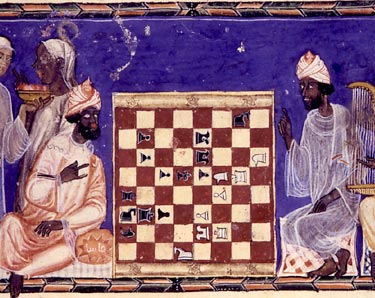
Chess originated in India and made its way to Europe via the Persians and Arabs. It symbolizes the world as the play of divine powers with their respective armies of light and darkness: devas vs asuras, gods vs titans, or angels vs demons. Thus Chess is a game for Kshatriyas, or Warriors.
The king represents the Heart, or Spirit, while the other pieces represent the various faculties of the soul. The movements of the pieces correspond to the realization of cosmic possibilities represented by the chessboard, actually a type of mandala: the castles are masculine, the bishops feminine, and the jump of the knights is intuition.
Much is lost today, since few any longer have the patience to play or even the ability to understand chess. Instead, energy is devoted to computerized games, which don’t represent the cosmic law, but rather the imaginary world construction of the game designer. Thus the will and intelligence of the player is secondary to the skilss of the designer.
Chess, on the other hand, represents the ability of the player to make his own destiny based on his intelligence and will. Titus Burckhardt describes it:
|
At each stage of the game, the player is free to choose between several possibilities, but each movement will entail a series of unavoidable consequences, so that necessity increasingly limits free choice, the end of the game being seen, not as the fruit of change, but as the result of rigorous laws.
While the player freely chooses his moves, they must be in conformance with the nature of the game. This applies, too, to our lives, which are played out in the world and need to conform to cosmic law, or Logos, to be successful. Only this gives us the freedom to create our destiny, as we can see that the outcome of the game is related to the choices we make. Burckhardt concludes:
The royal art is to govern the world—outward and inward—in conformity with its own laws. This art presupposes wisdom, which is the knowledge of possibilities; now all possibilities are contained, in a synthetic manner, in the universal and divine Spirit. True wisdom is a more or less perfect identification with the Spirit (purusha), this latter being symbolized by the geometrical quality of the chessboard, seal of the essential unity of the cosmic possibilities. The Spirit is Truth; through Truth, man is free; outside Truth, he is the slave of fate. That is the teaching of the game of chess; the Kshatriya who gives himself over to it does not only find in it a pastime or a means of sublimating his warlike passion and his need for adventure, but also, according to his intellectual capacity, a speculative support, and a way that leads from action to contemplation.
REFERENCE: “The Symbolism of Chess”, by Titus Burkhardt, included in “Mirror of the Intellect”.
Copyright © 2009, 2010 Gornahoor Press
The following quotes are taken from Rene Guenon’s “Introduction to the Study of the Hindu Doctrines”. They characterize the nature of the metaphysical enterprise.
Always and Everywhere
The object [of metaphysical knowledge] must always be absolutely the same and can in no way be something that changes of that is subject to the influences of time and place. [That is, it is true always and everywhere.]
Completeness
It is absolutely impossible to make any ‘discoveries’ in metaphysics, for in a type of knowledge which calls for the use of no specialized or external means of investigation all that is capable of being known may have been known by certain persons at any and every period; and this in fact emerges clearly from a profound study of the traditional metaphysical doctrines.
Immutability
The metaphysical point of view is radically opposed to the historical point of view, or what passes for such, and this opposition will be seen to amount not only to a question of method, but als, what is far more important, to a real question of principle, since the metaphysical point of view, in its essential immutability, is the very negation of the notions of evolution and progress.
Certitude
Not notice must be taken of contingencies such as individual influences, which are strictly non-existent from this point of view and cannot affect the doctrine in any way; the latter, being of the universal order, is thereby essentially supra-individual, and necessarily remains untouched by such influences. Even circumstances of time and space, we must repeat, can only affect the outward expression but not the essence of the doctrine; moreover there can be no question here, as there is in the relative and contingent order, of beliefs or opinions; metaphysical knowledge essentially implies permanent and changeless certitude.
Uncontestable
Metaphysics of necessity excludes every conception of a hypothetical character, whence it follows that metaphysical truths, in themselves, cannot in any way be contestable. Consequently, if there sometimes is occasion for discussion and controversy, this only happens as a result of a defect in exposition or of an imperfect comprehension of those truths.
Ineffability
Every exposition possible [of metaphysics] is necessarily defective, because metaphysical conceptions, by reason of their universality, can never be completely expressed, nor even imagined, since their essence is attainable by the pure and formless intelligence alone; they vastly exceed all possible forms, especially the formulas in which language tries to enclose them, which are always inadequate and tend to restrict their scope and therefore to distort them.
Knowledge of the Universal
Knowledge belonging to the universal order of necessity lies beyond all the distinctions that condition the knowledge of individual things. The object of metaphysics I in no wise comparable with the particular object of any other kind of knowledge whatsoever.
Being and knowledge are unified
When one speaks of the means of attaining metaphysical knowledge, it is evident that such means can only be one and the same thing as knowledge itself, in which subject and object are essentially unified. [That is, metaphysical knowledge is possible only with a change in one’s level of being or state of consciousness.]
Non-discursive
The means [of achieving metaphysical knowledge] cannot in any way resemble the exercise of a discursive faculty such as individual human reason.
Beyond Rational
We are dealing with the supra-individual and consequently with the supra rational order, which does not in any way mean the irrational: metaphysics cannot contradict reason, but it stands above reason, which is only a secondary means for the formulation and external expression of truths that lie beyond its province, and outside its scope.
Intuition
Metaphysical truths can only be conceived by the use of a faculty that does not belong to the individual order, ant that, because of the immediate character of its operation, may be call intuitive.
Direct knowledge of principles
The intellect is that faculty which possessed a direct knowledge of principles.
Truer than science
Aristotle declares that “the intellect is truer than science”, which amounts to saying that it is more true that the reason which constructs that science.
Infallible
It is necessary infallible because of the fact that its operation is immediate and, not being really distinct from its object, it is identified with the truth itself.
These characteristics are perfectly clear to someone who understands them, but are opaque to someone who does not. But, to apply them to particular situations: neither the individual nor mankind as a whole, “evolves” into higher knowledge. Debates about particular exterior forms are worse than futile (e.g., the alleged debate between pagans and Christians.) It is transcendent and hence to reducible to any biological process.
In conclusion, there is no point in “debating” any of these characteristics. Hence, comments should be restricted to clarifications only.
Copyright © 2009, 2010 Gornahoor Press
2010-05-08
What follows is a brief précis of the fundamental point of view of the Gornahoor project.
Epistomology
We hold to three degrees of knowledge:
- Doxa (sensus, opinion, sensual knowledge). Direct, intuitive knowledge through the senses. I taste the sweetness and moistness of a mango.
- Dianoia (ratio, rational knowledge). Indirect knowledge, discursive reasoning, science. I study the structure of the mango and its history as a crop.
- Episteme (intellectus, intuition). Direct, intuitive knowledge of the supra-sensible. I grasp the idea of a mango.
Ontology
- Spirit is prior to matter
- The great chain of being from God, to the spiritual hierarchy, man, animals, plants, matter
Anthropology
This science describes the nature of man. Man, such as he is, exists in one of three states.
- The sensual man is focused on doxa, or the satisfaction of his material needs and desires. His opinions come ready-made from his social groups and are not questioned or investigated.
- The rational man seeks to investigate the sources of the sensual world. There are two options:
- Science. Only the sensual world exists. Knowledge is achieved by investigating the facts of the sensual world and forming general laws to explain them.
- Religion. A supra-sensible world exists, but there is no way to know it directly. Hence, it is accepted as a matter of belief, based on authority or revelation.
- The intellectual man has direct access to and knowledge of the supra-sensible realm.
Cosmology
The sensual world is the reflection of the spiritual world and, thus, has no independent existence. It evolves, in the original sense of the world: as the unfolding of an originary idea. An analogy is that of a symphony, which exists as an idea until musicians perform it; thus the symphony is revealed in the sensual world. As a whole, the world process is the unfolding of the three fundamental ideals.
- Beauty. The world process is a creative process, revealing beauty and harmony.
- Good. The sufficient reason for the world is the Will. Hence, the world process is a moral action, based on virtue (manliness, strength). The world comes into existence through Power.
- Truth. The world is a reflection of the Logos (reason, law). Hence, the world process must follow the logos, or else descend into formlessness. The unity of the logos is highly differentiated and hierarchical, since it is infinite and subject to no limitation.
Politics
Politics, as the “queen of the sciences”, describes the proper relations of men in their social groupings. As such, it must take into account the findings of all the other sciences, including Anthropology and Cosmology. Hence, all contemporary divisions into left and right are misleading, and ultimately ineffective.
As Evola pointed out, the correct political position is what “every well-bred man considered sane, healthy, and normal prior to the French revolution.” That is, the harmonious over the discordant, the good over the perverse, order over disorder and the undifferentiated mass.
The battle, therefore, is between those who would uphold the Traditional order, and the various revolutionary forces that seek to overthrow it. The revolution operates on multiple fronts.
Western Tradition
The Western Tradition is based on the axis from Greece and Rome, and its prolongation in time to Paris (Charles Maurras). We would extend that back even further to its Indo-European roots in Egypt, Persia, India. We, therefore, see continuity from the classical period to the Catholic medieval era and even into modern times.
We acknowledge the existence of a Western esoteric tradition, which at various times has made itself known and at others, has had to hide itself. This tradition has been based on Hermeticism, whether the ancient pagan mysteries or Christian alchemy. The goal of this Tradition is the reintegration of man into his Primordial state; this is true, whether pagan or Christian.
Hence, we reject the typical superficial distinctions between pagan and Christian. This requires the simultaneous rejection of those vulgar expressions of paganism as the life of non-transcendent sensuality, and Christian other-worldliness unnourished by its esoteric sources.
Copyright © 2009, 2010 Gornahoor Press
Next Page »
|