2009-10-31

Evolution and the Order of Being

Filed under: Evolution,Vladimir Solovyov — by Cologero @ 07:08

The fact the higher forms and types are manifested or revealed following the inferior ones by no means proves that they are the product or creation of the inferior realm. The order of being is not identical to the order of phenomena. The higher, more positive and fuller types and conditions of being exist (metaphysically) before the inferior ones, though they manifest and reveal themselves after them. This does not mean a denial of evolution; evolution is a fact. But to assert that evolution creates higher forms entirely out of inferior ones—that is, finally out of nothing—means to found a fact on a logical absurdity. The evolution of inferior types of being cannot by itself alone create superior types, but it does create material conditions and offer the necessary milieu for the manifestation or revelation of the superior. Thus every manifestation of a new type of being is in a certain sense a new creation, but a creation which can least of all be designated as a creation out of nothing; for firstly, the natural basis for the birth of the new type is offered by the former one; and secondly, the superior types own positive contents does not arise out of non-being, but exists from all times. It only enters (at a certain point of the process) into another sphere of phenomena. The conditions of the phenomenon depend on natural evolution; that which is revealed depends on God.

~ Vladimir Soloviev

Copyright © 2009, 2010 Gornahoor Press

2009-10-24

Woman is the bearer of the sex-element

Filed under: Nicolas Berdyaev,Quotes,Sexuality — by Cologero @ 18:52

Woman is the bearer of the sex-element in this world. In man sex is more differentiated and specialized: in woman it is diffused through the whole tissue of the organism, through the whole structure of the soul. In man sexual attraction demands more immediate satisfaction than in woman, but he is more independent of sex than is woman: he is a less sexual being. Man is greatly dependent, sexually, on woman: he has a weakness for the other sex, a radical weakness which may be the source of all his weaknesses.

And for man his weakness for woman is something degrading. By himself man is less sexual than woman. In woman there is nothing which is not sexual: she is sexual in her strength and in her weakness, sexual even in the weakness of her sexual desire. Woman is the cosmic universal bearer of the sexual element, of the elemental in sex. The element of sex natural to the genus is a feminine element. The power of the race (genus) over man is realized through woman. This power entered the world of nature and took control of it through the first mother, Eve. Eve is the natural-racial womanliness.

The creation of Eve brought the old Adam under the power of race-sexuality, fettered him to the natural world, to "this world." "The world" caught Adam and rules him through sex: Adam is fettered to natural necessity at the point of sexuality. Eve’s power over Adam became the power of all nature over him. Man, bound to the birth-giving Eve, became the slave of nature, the slave of a womanliness separate and differentiated from his androgynous image and likeness of God. The attitude of the male man towards womanliness is the root of his attitude towards nature. He can escape neither womanliness nor nature—there is nowhere where he can get away. Deliverance is possible only through the new Adam, who comes into the world through a new womanliness. The sinful power of female nature over the fallen man began with the woman, Eve: with the Virgin Mary began man’s liberation from that natural power. In the Virgin Mary the earth takes into its house the Logos, the new Adam, the Absolute Man.

And if the fall and enslavement of the old Adam, the old man, confirmed in the world the rule of nature-racial birth through the sexual act, the new Adam, the new man, could be born only of a virgin, who conceived by the Spirit.

The new birth from a virgin was a mystical conquest of the old birth in the natural order the “this world.” Eternal womanliness, as the basis of a new world, liberated from sin, shall not give birth as the result of the sexual act of man. Eternal womanliness bears within itself release from natural necessity, since natural necessity rules over man only through the birth-giving sex. The religion of redemption denies both race and the sexual act and set up the cult of eternal womanliness, the cult of a Virgin giving birth only through the Spirit.

~ Nicolas Berdyaev, from The Meaning of the Creative Act

Copyright © 2009, 2010 Gornahoor Press

2009-10-20

Scientific Clarity and Assurance

Ce que nos pères ont fait par coutume et par sentiment, le poursuivre nous-mêmes avec l’assurance et la netteté scientifiques par raison et par volonté.

What our fathers did through custom and feeling, we ourselves pursue it through reason and will, with the assurance and clarity of science.

~ Charles Maurras

With this quote, we see the dominating influence of Auguste Comte’s system of positivism on Maurras’ entire political program. The other dominant influence was Joseph de Maistre, with his love of Tradition structured by the Church and the Monarchy. However, unlike Maistre, Maurras did not have Maistre’s indomitable Catholic faith to justify his worldview. Nevertheless, Maurras accepted Comte’s claim to have discovered the true scientific basis for de Maistre’s views.

Of the two great “fathers” of a scientific sociology in the 19th century — Marx and Comte — Marx has won out handily and Comte is nearly forgotten. So we are left with a view of science that allegedly supports the forces of revolution. That this “science” is ideological, is all too obvious. Comte, on the other hand, rejected both religion and ideology, in favour of a purer science, which was simiply the exposition of laws concering what can be seen or touched. As cush, it avoided both metaphyscal pre-suppositions (e.g., materialism) and reductionism. In place of the latter, Comte proposed a hierarchy of sciences, even leaving room for a scientific ethics.

Nevertheless, Comte gets little support primarily because self-described religious conservatives have no interest in supporting Comte’s atheism or Maurras’ paganism. On the other side, secular rightists believe they can corral Darwin to their own ends, and accept its materialism and reduction as “rational”, often adopting a form of zoological racism. These secularists also oppose the role of religion in society, which they regard as mere superstition, whereas Comte and Maurras accept religion as a natural conservative and stabilizing force. What religion accomplished through “custom and sentiment”, the positivists seek the same ends through “reason and will”.

Copyright © 2009, 2010 Gornahoor Press

2009-10-15

Tao and Logos

Filed under: Metaphysics — by Cologero @ 09:04

Update
A conference on the book “Christ the Eternal Tao” by the author Hieromonk Damascene is available at Ancient Faith Radio.

Learn how Eastern Orthodox Christian spirituality provides seekers of our day clear guidance on acquiring stillness, overcoming the passions, dealing with thoughts, and cultivating the virtues, as well as precise teachings on spiritual *deception, all of which* guides seekers more safely and surely on the path to communion with God (Tao – Chinese). In the profound mystical and contemplative tradition of the Christian East, seekers are able to go well beyond the realizations in Eastern religions. A long – awaited answer for those who, having turned away from modern Western religiosity, are drawn to the freshness, directness and simplicity of Lao Tzu and eastern philosophies, and at the same time are strangely, inexplicably drawn back to the all-compelling reality of Jesus Christ.


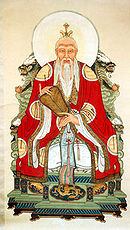
My teachings are very easy to understand and to practice; yet there is no one in the world who is able either to understand or to practice them. This is because my teachings have an originating principle and arise from an integrated system. This is not understood, so I am unknown.

~ Lao Tzu

Lao Tzu
Heraclitus

Of the Logos, which is as I describe it, people always prove to be uncomprehending, both before and after they have heard of it. For although all things happen according to this Logos, people behave as if they have no experience, even when they experience such words and deeds as I explain, when I distinguish each thing according to its constitution and declare how it is. The rest of humanity fails to notice what they do after they wake up just as they forget what they do when asleep.

~ Heraclitus

Copyright © 2009, 2010 Gornahoor Press

2009-10-14

The Flowering of European Civilisation

Filed under: Donoso Cortes,News,Western Civilization — by Cologero @ 07:37

To the profound comprehension of this law of the intellectual generation of ideas, are due the marvels of Catholic civilisation. To that wonderful civilisation is due all that we admire and all that we see. Its theologians, even considered humanly, put to the blush modern and ancient philosophers; her doctors excite wonder by the immensity of their science; its historians by their generalising and comprehensive views, cast those of antiquity into the shade. St Augustine’s “City of God” is, even today, the most profound book of history which genius, illuminated by the rays of Catholicity, has presented to the astonished eyes of men. The acts of her Councils, leaving aside the divine inspiration, are the most finished monuments of human prudence. The Canonical, excel in wisdom the Roman, and the feudal, laws. Who is before St Thomas in science, St Augustine in genius, Bossuet in majesty, St Paul in power? Who is greater as a poet than Dante? Who is equal to Shakespeare? Who surpasses Calderon? Who, like Raffaelle, infused life and inspiration into the canvas?

Place people in sight of the pyramids of Egypt, and they will tell you, “Here has passed a grand and barbarous civilisation.” Place them in sight of the Grecian statues and temples, and they will tell you, “Here has passed a graceful, ephemeral, and brilliant civilisation.” Place them in sight of a Roman monument, and they will tell you, “Here has passed a great people.” Place them in sight of a cathedral, and on beholding such majesty united to such beauty, such grandeur to such taste, such grace to such delicacy, such severe unity to such rich variety, such measure to such boldness, such heaviness in the stones, with such suavity in their outlines, and such wonderful harmony between silence and light, shade and colour, they will tell you,

Here has passed the greatest people of history, and the most astounding of human civilisations: that people must have taken grandeur from the Egyptian, brilliancy from the Greek, strength from the Roman, and, beyond the strength, the brilliancy, and grandeur, something more valuable than grandeur, strength, and brilliancy—immortality and perfection.

Donoso Cortes, Essays on Catholicism, Liberalism and Socialism

Copyright © 2009, 2010 Gornahoor Press

2009-10-13

Roots of Western Civilisation

Filed under: Dumezil,Julius Evola,Savitri Devi,Western Civilization — by Cologero @ 03:34

Of the many would-be “saviours” of Western civilisation, there are precious few who know exactly what they are supposed to preserve. For example, many prefer the values of the Enlightenment and praise scientific discovery; while that may be, in a restricted sense, one of the flowers, it is hardly the root.

To locate the roots, the first source would be the works of George Dumezil, who identified the common social and religious structures of Indo-European peoples from Vedic India to Ireland, and all points in-between. Even if you deny that this was the work of a particular race, it cannot be denied that it was the manifestation of a particular spirit.

In “Sintesi di dottrina dell razza”, Julius Evola mentioned the qualities “characteristic of the great Aryan civilisations of the Orient, ancient Rome, up to the Roman-Germanic Middle Ages”. So to understand the roots of Western civilisation, it is necessary to return to those sources: the Vedic civilisation of India, the classical civilisations of Greece and Rome, and finally the Catholic Middle Ages as created by the Germanic and classical Roman currents.

Let us not forget, there was no “Europe” until the Middle Ages. Ancient Rome was built around the Mediterranean and included what is now called the Near East and the Mahgreb. Savitri Devi in “Son of the Sun” writes:

If we consider the Western world as a whole (Europe and its background), and not only the small portion of it which one generally has in mind when speaking of “the West”, then we have to include in it the countries of the Bible—Syria, Egypt, Arabia, Iraq—no less than Greece; for they are the geographical and cultural background of Christianity, the religion of Europe for centuries.

After the Middle Ages, Western civilisation takes a different turn and, no longer nourished by its roots, its decline commenced.

Copyright © 2009, 2010 Gornahoor Press

2009-10-03

Stages of Man

Filed under: Metaphysics — by Cologero @ 08:07
Tags: , ,

There are three stages to become a man: unnatural man, natural man, and supernatural man.

  1. Unnatural Man. Man, such as he is, is in an unnatural state, that is, he is not, properly speaking, even a man. As Julius Evola describes it:

    the “I” still lives only as if in a dream: it is not yet a self-consciousness, nor an autonomous principle of action: immersed in an immediate, indistinct coalescence with nature and the world, we can say that it is not so much he who thinks, speaks, and asserts himself, as much as that various forces and impulses think, speak and assert themselves in him. He therefore is only a type of medium, a passive instrument that has his very life outside himself, and he experiences everything as grace, as spontaneity, as the immediate self-manifestation of something that transcends him. (“Man and the Becoming of the World”)

    Such a man is a slave to his passions and the faculty of reason, when it is developed, serves only as a tool to satisfy those passions. This is “man” as understood by Darwinism.

  2. Natural Man. This type of man is defined by his rationality: Man is a rational animal; but not rational in the restricted instrumental sense of the unnatural man, nor even those learned in books and science. Rather this is a man whose reason dominates and controls the passions and whose will has the power to implement his projects. This type of reason is not merely instrumental, but is all-encompassing, leading to right thought and right action … that is, such a man lives according to his own nature.
  3. Supernatural Man. A further stage can be reached when the “I” transcends its identity as a man simpliciter. This “I” knows itself as “I” and understands that the human state is just one of its possible states of being. At this stage, one can truly be called a god-man.

Copyright © 2009, 2010 Gornahoor Press

2009-10-01

To Become a Man

Filed under: Quotes — by Cologero @ 09:08
Tags: , ,

To become a man at once is impossible. One has to mould oneself into a man. Here discipline is required. But it is precisely this relentless self-discipline that our present-day thinkers reject. Now it is in the relentless self-discipline and uninterrupted work on one’s self that our citizen could reveal himself.

Dostoievsky, from Diary of a Writer

Copyright © 2009, 2010 Gornahoor Press